
What Does the Flathead’s Housing Shortage Look Like?
A deep dive into assessments of housing needs over the next 20 years in Columbia Falls, Kalispell, and Whitefish.
What does state law require that cities do for housing when planning for future growth?
The Montana Land Use Planning Act (MLUPA) requires cities to project their population growth over the next 20 years. After doing this, cities must then determine the number of homes that they need to provide to meet these future population needs. These housing needs are then incorporated into the Land Use Plan and Future Land Use Map, and cities need to have a plan to provide the needed number of homes that was determined earlier.
Ultimately, this will be done by updating zoning ordinances to ensure that the number of homes needed in the future can be built by-right, without additional public hearings. This allows cities to keep housing costs lower and prevent displacement by reacting more quickly to surges in demand for homes.
These requirements aren’t just theoretical — cities will need to review their progress toward meeting their housing needs every 5 years by reviewing the Land Use Plan.
How many homes do we need to build in the flathead valley over the next 20 years?
Columbia Falls, Kalispell, and Whitefish have already published their assessments of housing needs which contain the cities’ best estimates for how many homes they need to build over the next 20 years. Below, we are going to dive into each of them individually. We will start with the number of homes needed over the next 20 years, and then we’ll dive further into some more of the specifics contained in the reports.
Columbia Falls
new Homes needed by 2045: 890 - 1,300*
Click here to view the Columbia Falls Housing Needs Study
Click here to visit the Columbia Falls Land Use Plan Engagement Website
*this number does not tell the full story, we’ll get into that below
Columbia Falls’ Housing Needs Study was completed in March 2025 and is 82 pages long. The study horizon was only 10 years, so the housing needs from the study were doubled to determine the housing needs over a 20-year planning horizon. Below, we will concisely summarize the main findings of the study.
Study Area:
The City of Columbia Falls (“Columbia Falls” or “City”).
59912 zip code area (“Columbia Falls Area” or “Area”).
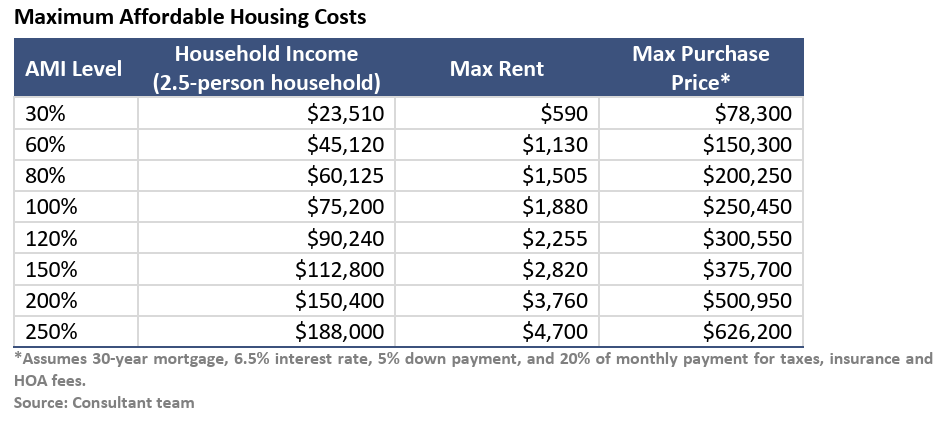
What is “affordable” housing?
Defined as a monthly housing payment less than or equal to 30% of a household’s GROSS income (income before taxes).
“Area Median Income” (AMI) varies by household size and can be used to determine maximum affordable housing costs.
See the table below (from the study) as an example for a 2.5-person household (the average household size in Columbia Falls)
Future Housing Needs:
As previously stated, the future housing needs numbers from the study were doubled to extrapolate from a 10-year to a 20-year planning horizon, which is required by MLUPA. This is where we need to dive deeper into the number of homes needed by 2045 that was noted above, because we need to factor in the additional housing needs in the 59912 zip code that exist outside of the City of Columbia Falls.
New homes needed by 2045, Columbia Falls City: 890 - 1,300
New homes needed by 2045, Columbia Falls Area: 2,800
Let’s discuss what this means. These numbers say that the majority of new homes that are needed by 2045 are expected to be built outside of the City of Columbia Falls, on county land in the 59912 zip code. By 2045, the study estimates that the number of homes that will need to be built outside of Columbia Falls city limits in the 59912 zip code is 1,500 - 1,910, or 53.6% - 68.2%* of the total housing need.
*In practice, how much of this housing need is accommodated within the city limits versus on county land sprawling outside of city limits is a policy choice that will be decided as the city and community work through creating a new Land Use Plan between now and May 2026.
Commuting Statistics:
About 2,550 employees (54%) commute into the Columbia Falls Area for work.
About 400 employees (<10%) live outside of Flathead County, including employees that work remotely.
Employers estimate that about 37% of their commuting employees would prefer to live in the Columbia Falls Area if housing they could afford was available.

Employer Sentiments Related to Workforce Housing Challenges:
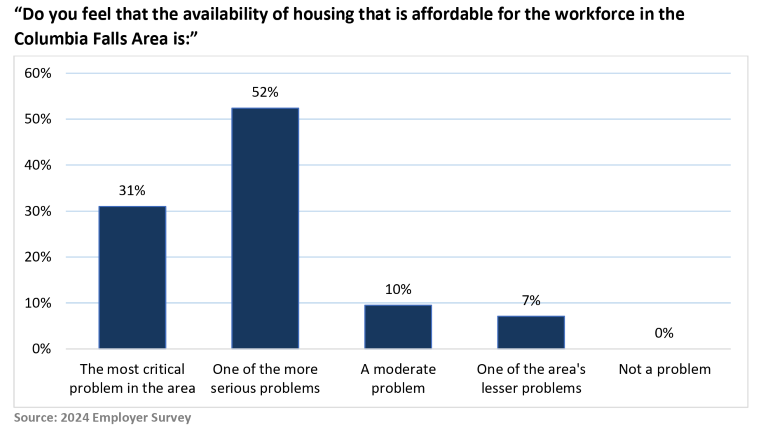
A majority of employers feel that the availability of housing that is affordable for the workforce in the Columbia Falls Area is one of the more serious problems, with an additional 31% identifying it as the most critical problem.
Employers that hire seasonal summer employees were more likely to identify housing affordability as the most critical problem.
Three-quarters of employers experienced at least one workforce challenge related to housing and cost-of-living in the area over the past 12 months.
Employers also reported problems with unqualified or no applicants to jobs, employee turnover (due to leaving the Flathead or wage competition in the Flathead), and tardiness/absenteeism (a potential side-effect of commuting from out of town).
Employers report that employees across all employment levels (minimum wage to upper management) have difficulty finding housing that they can afford.
Current Real Estate Trends (Ownership Market):
The median residential home sales price in the Columbia Falls Area rose 85% between 2019 and 2024, to $575,000.
This is more than both Flathead County (81%) and Kalispell (77%), but less than Whitefish (125%).
This is just below the Flathead County median sales price and is 8% higher than Kalispell.
It requires an income of ~$180,000 at a 6.5% interest rate to afford to purchase a $600,000 home.

Homes need to be priced between $200,000 and $400,000 to be affordable for households earning between $60,000 and $120,000 (80% to 160% AMI).
Current Real Estate Trends (Rental Market):
~23% of households in the Columbia Falls Area are renters, and ~36% of households within the City of Columbia Falls are renters.
In early 2025, the rental vacancy rate was 3.5 - 4.5%, which represents a tight rental market.
This has increased in recent years, indicating some loosening in the rental market following the pandemic.
Since 2019, median gross rent in the City of Columbia Falls increased at a faster rate than other communities in the Flathead, averaging 9.2% per year.
While Columbia Falls still has the lowest median rent in the Flathead, it is only 9% lower than the rest of the county. In 2019, it was 21% lower than the rest of the county.
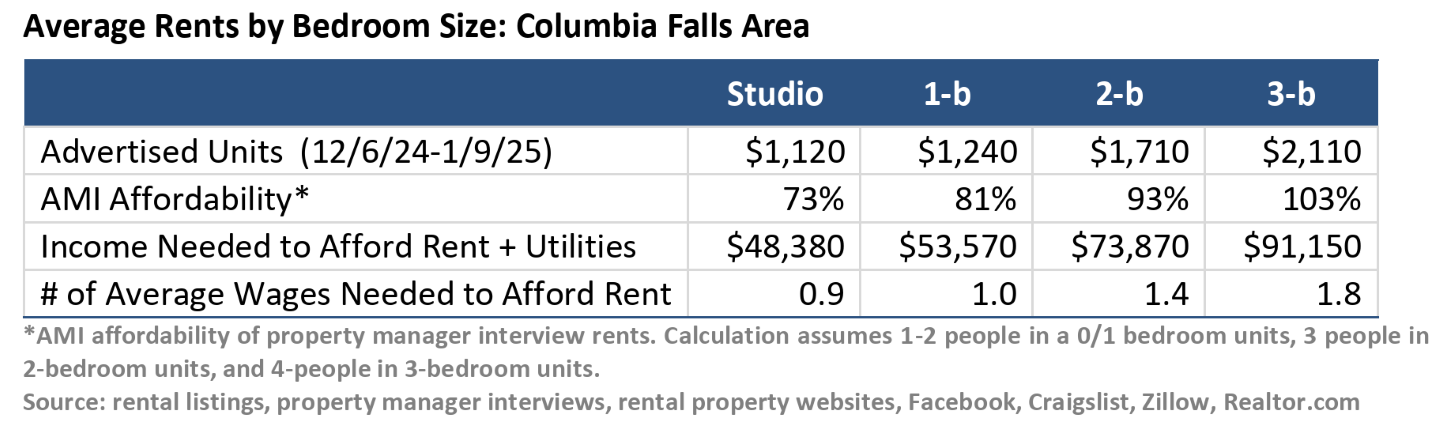
Current market rents in the Columbia Falls Area are affordable for households earning between 80% and 100% of AMI, ranging from $1,120 to $2,110 depending on unit size.
Kalispell
new Homes needed by 2045: 8,800 - 10,000
Click here to view the Kalispell Housing Element (view “Housing” document)
Click here to visit the Kalispell Land Use Plan Engagement Website
Kalispell did not commission a large study similar to Columbia Falls and Whitefish. Instead, they used a 2.5% annual growth rate to estimate future population growth (54,392 residents by 2045) and future housing needs. Kalispell’s historic growth rate is near 2% annually, however, this figure was adjusted upward to 2.5% to account for the city’s recent increased rate of growth. This growth rate combined with Kalispell’s average household of 2.4 persons (and an assumed 5% vacancy rate) led to the calculation of 8,800 - 10,000 new homes needed by 2045.
Current Real Estate Trends (as of Spring 2025):
Average rent is $1,650/month (compared to the national average of $1,825).
$150/month decrease over the previous month and $135/month decrease year-over-year.
Kalispell’s rental vacancy rate is just 1.1%, indicating significant supply constraints in the rental market.
Median home value is $574,000.
This is down from $640,000 in 2022.
Kalispell Has Approved A Lot Of Homes Recently, Right?
Yes.
The city reports that between 2021 and 2025, it has approved ~7,500 new homes to be built. Of these, ~2,000 have already been constructed, leaving ~5,550 homes in the development pipeline. If all 5,500 of these previously approved homes are built, they will account for 75-85% of the city’s need by 2045.
BUT. This is a big if. It is common for approved developments to not be built for a variety of reasons. In our opinion, it is important that the city closely monitor these projects and continue to plan contingencies to ensure that the city can meet its housing goals.
Land Availability:
Kalispell currently has 8,436 acres of land within its municipal boundaries.
~2,484 acres (29.5%) of this is vacant land.
~2,389 acres (96%) of this vacant land would support housing.
Outside of city limits within Kalispell’s annexation boundary, there is an additional 3,871 acres of vacant land.
3,330 acres (88%) of this vacant land would support zoning that could allow for residential use.

Whitefish
new Homes needed by 2045: 1,860
Click here to view the Whitefish Housing Needs Assessment
Click here to visit the Whitefish Land Use Plan Engagement Website
Whitefish’s Housing Needs Assessment was completed in August 2025 and is 46 pages long. This is an update of the city’s 2022 Housing Needs Assessment, which was an update of the city’s 2016 Housing Needs Assessment. The study horizon was only 10 years, so the housing needs from the study were doubled to determine the housing needs over a 20-year planning horizon. Below, we will concisely summarize the main findings of the study.
Study Area:
While the 2022 study looked at the entire 59937 zip code area, this study focuses only within Whitefish’s City Limits.

Future Housing Needs:
As previously stated, the future housing needs numbers from the study were doubled to extrapolate from a 10-year to a 20-year planning horizon, which is required by MLUPA. The average household size in Whitefish is 2.02, which is less than both Columbia Falls and Kalispell.
New homes needed by 2045: 1,860
For ownership: 684
For rent: 1,176
Rehab/Renovation of Existing Homes by 2045: 1,078
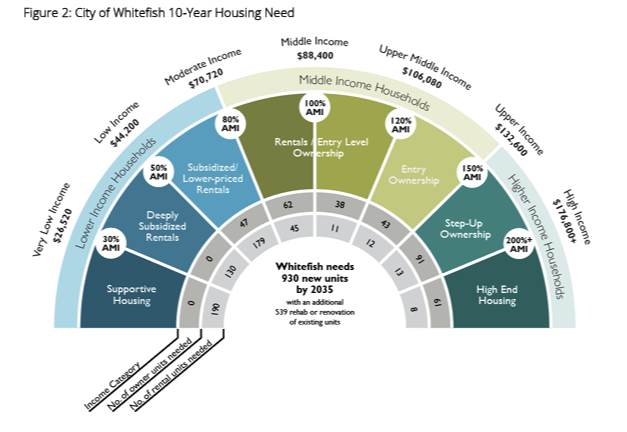
As we can see from the figure above, ~59% of Whitefish’s housing needs are for those earning 80% of AMI or less.
For a family of 4, this represents two people earning $17/hour or less each or one person earning $34/hour or less.
For a single-person household, this represents someone earning $23.80/hour or less.
Commuting Statistics:
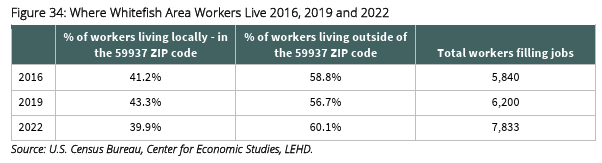
About 4,700 employees (60%) commute into the Whitefish Area for work.
These commuters are primarily coming from Kalispell, Columbia Falls, Hungry Horse, and West Glacier.
This number of commuters has continued to increase over time.
Current Real Estate Trends (Ownership Market):
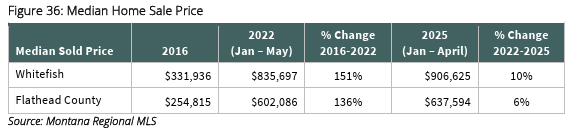
The median residential home sales price in Whitefish more than doubled between 2016 and 2022 and rose an additional 8.5% between 2022 and early 2025, to $906,625.
These increases outpace the rest of Flathead County since 2016.
It requires an income of ~$270,000 at a 6.5% interest rate to afford to purchase a $900,000 home.
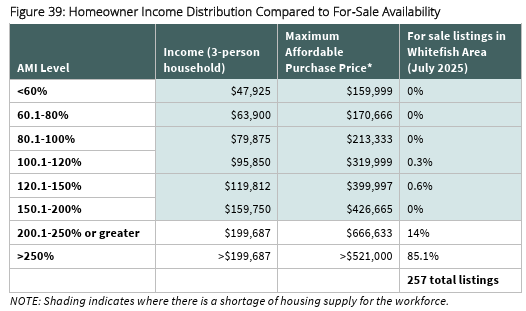
There are very few homes available for purchase for those earning <200% AMI (<$176,800 for a family of 4).
The average household size for homeowners in Whitefish is 2.33.
Less than 20% of homeowners in Whitefish are cost-burdened.
Current Real Estate Trends (Rental Market):
~40% of households within the City of Whitefish are renters.
69% of renters in Whitefish have an annual income of $50,000 or less.
61% of renters in Whitefish are cost-burdened, with 38% of renters being severely cost-burdened.
The average household size for renters in Whitefish is 1.55.
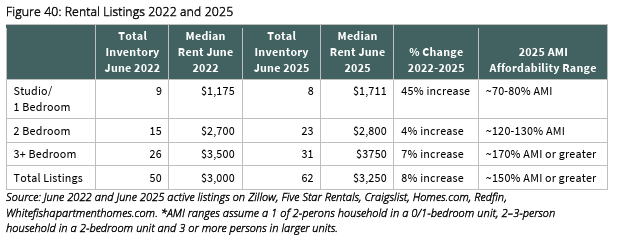
Since 2022, median rent has increased 8% overall, but studio and 1-bedroom apartments have increased by 45%.
The median rent for all listings in June 2025 was $3,250/month, with rents ranging from $1,711 - $3,750, depending on unit size.
This indicates that half of all available rentals are only affordable to those earning >150% AMI.
Senior Housing Demand:
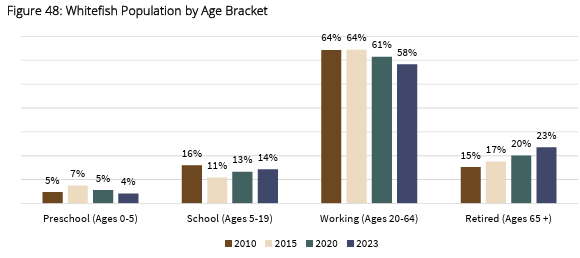
Whitefish is growing older, and approximately 1 in 4 residents is over the age of 65.
There are limited options in Whitefish for downsizing into more accessible homes as people age.
This can reduce the availability of family-sized homes further as older adults remain in their homes as they are unable to downsize.
Conclusion
The Flathead Valley will need to construct more than 12,000 new homes inside the cities of Columbia Falls, Kalispell, and Whitefish by 2045 to keep pace with projected population growth-induced demand. It is inevitable that homes will also continue to be built on county land outside of our cities. It is currently estimated that 64% of Flathead County residents live outside of the city limits of Columbia Falls, Kalispell, and Whitefish. If this pattern were to continue, then we could see a total of more than 33,000 new homes in Flathead County by 2045.
The question we need to ask ourselves is: If population growth-induced demand led to the construction of an additional 33,000 homes in Flathead County, then where would we like to see these built? Do we want these to eat up large swaths of agricultural land and open space outside of our cities, or would we prefer that the majority of these homes be built inside of our cities?
If we want to avoid traffic congestion, the loss of rural spaces, and give people more choice about where they live, then we need to focus on making sure that our cities are prepared to handle as much of this housing demand as possible. Watch out for future posts on our blog that weigh the pros and cons of these choices.
